
Four things decide whether a Southwest Florida beach day is a good one: the water, the current, the sun, and the time of year. None of them are complicated once you know what to look at. Here is the whole picture in one place, so you can check it in two minutes before you drive.
Red tide
Red tide is a harmful algal bloom — colonies of microscopic algae multiplying fast enough to release toxins that affect fish, shellfish, birds, marine mammals and, at the edges, people. In the Gulf it is caused by Karenia brevis, and it is a naturally occurring phenomenon rather than a new one.
What it means for you is usually mild and very local: itchy eyes, a scratchy throat, a cough near the water when the wind is onshore. People with asthma or sensitive skin feel it first and worst. If irritation starts, leave the water, rinse thoroughly with fresh water, and move up the coast — conditions genuinely can be bad at one beach and fine ten miles away.
Where to check: the Florida Fish and Wildlife Conservation Commission publishes a red tide status map, and the Florida Department of Health posts beach-level advisories. Both update regularly, and both are more current than anything a rental company could tell you.
Our cancellation policy covers this. If conditions make the day genuinely unpleasant, talk to us — the terms are on our weather and cancellation page. We would rather move your day than have you sit through a bad one.
Rip currents
A rip current is a narrow channel of water flowing away from shore, usually straight out through a gap in a sandbar. They are not undertows and they do not pull you down — they pull you out, which is survivable if you know what to do and dangerous if you panic and swim against it.
If you are caught in one:
- Stay calm. It pulls outward, not downward.
- Swim parallel to the shore until you are out of the channel, then angle back in.
- If you cannot swim out of it, float or tread water and let it release you — most rips weaken within a few hundred feet.
- Signal for help by waving one arm and shouting.
If someone else is caught: tell a lifeguard, call 911, and throw them something that floats. Do not swim out without a flotation aid — that is how the second drowning happens.
Read the flags. Southwest Florida beaches fly the standard warning flags: double red means the water is closed, single red means high hazard, yellow means moderate surf or current, green means calm, and purple means dangerous marine life such as jellyfish. Purple can fly alongside any of the others.
Sun
The UV index here runs high most of the year, and it peaks between roughly 10:00 AM and 4:00 PM — which is precisely the window a beach day occupies. Shade is not a luxury in that window; it is the thing that decides whether day three of your holiday is comfortable.
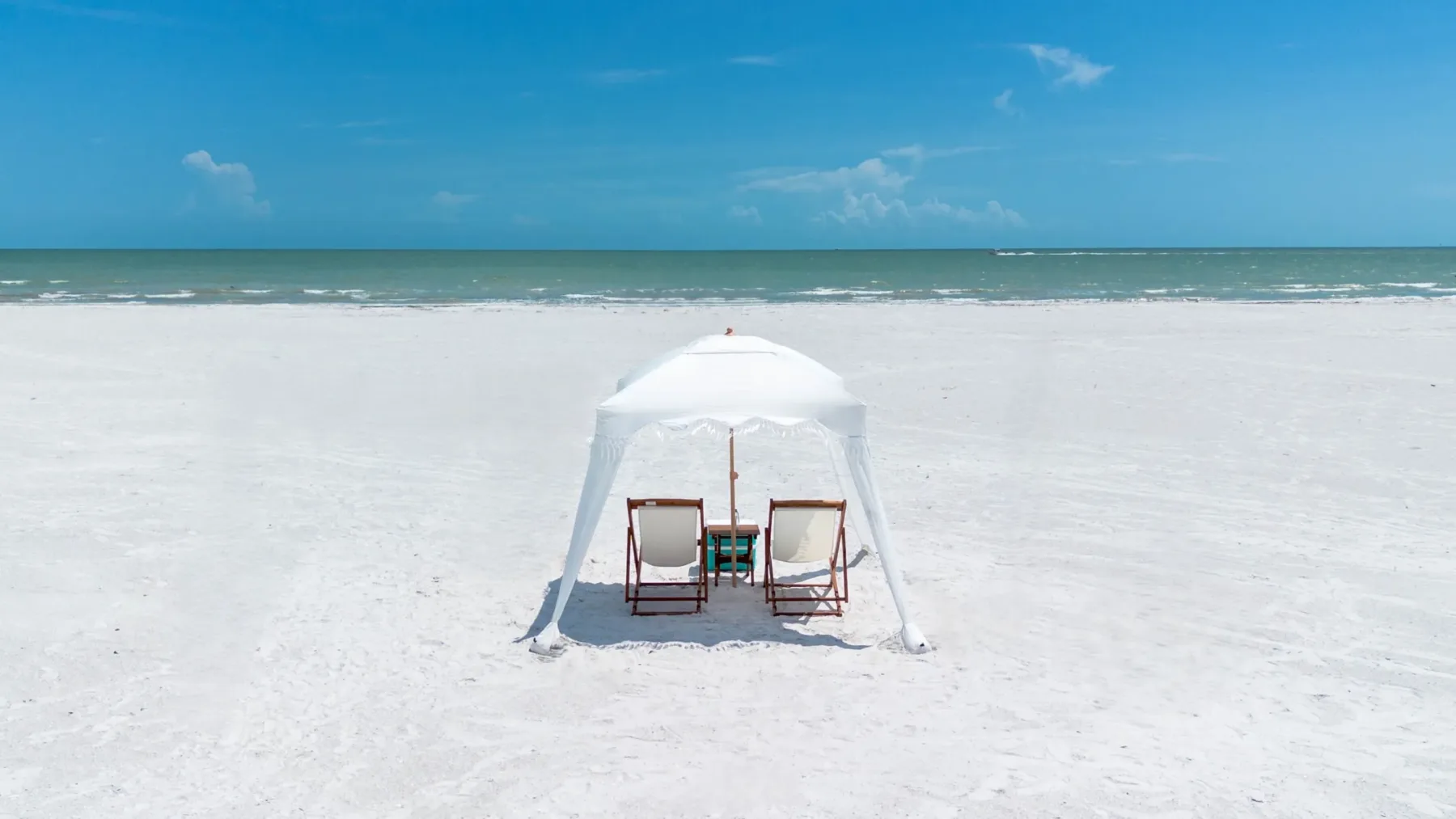
Bring and reapply your own sunscreen. To be clear about what we do and do not provide: every setup includes a shaded cabana, chairs, a table, a cooler with ice and bottled water, and Turkish towels. Sunscreen is not included — bring your own, and reapply after swimming.
Sea turtle nesting season
Nesting season on Gulf beaches runs roughly May through October. Loggerheads are the most common nesters here, and both the turtles and their nests are protected under the federal Endangered Species Act and Florida law. It is illegal to touch or disturb a nesting turtle, a hatchling or a nest.
What that means in practice:
- Roped-off nests near the dunes are marked for a reason. Give them a wide berth. We place cabanas a respectful distance from any marked nest as a matter of course.
- Hatchlings emerge at night, not in the morning. What you are likely to see at dawn is tracks — small parallel flipper marks running from the dunes to the water.
- Lights disorient them. If you are on the beach after dark in season, avoid white light and phone torches near the dunes.
- Fill in holes and take everything with you. A hole dug for fun is a trap for a hatchling, and gear left overnight blocks the route to the water. We take every piece of our setup away at the end of the day.
If you find a hatchling in trouble or a disturbed nest, call the FWC Wildlife Alert hotline rather than intervening yourself.
The two-minute check before you drive
- Red tide status — FWC map or the Florida Department of Health advisory for your beach
- Surf and rip current forecast — the National Weather Service marine forecast for the Gulf coast
- The flag at the beach itself — it beats any forecast, because it is right now
- The month — May to October, watch for marked nests
Conditions vary beach to beach and change fast. Once you know the coast is clear, our local guides cover parking and access for Bonita Beach, Fort Myers Beach, Naples and Sanibel.
Red tide status is published by the Florida Fish and Wildlife Conservation Commission and the Florida Department of Health. Sea turtle protections are enforced under the federal Endangered Species Act and Florida law. Conditions change daily — always check current sources before you travel.